
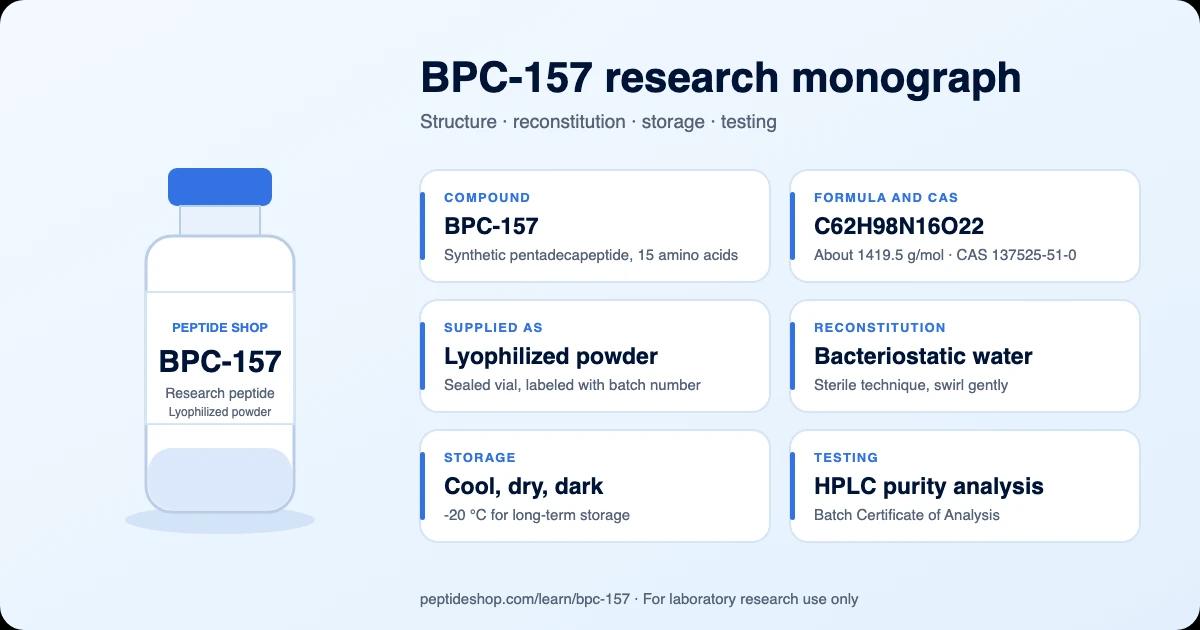
BPC-157 is a synthetic peptide of 15 amino acids, used as a reference compound in laboratory research. This monograph lists its chemical profile and explains how to reconstitute, store and verify it. For background on the compound, read What Is BPC-157? It is written for researchers and is provided for laboratory research use only.
Reviewed by: [name and role] · Last updated: [date]
BPC-157 Amino Acid Sequence and Structure
BPC-157 is a pentadecapeptide, a chain of 15 amino acids, produced by solid-phase peptide synthesis (SPPS). Its full chemical profile is below, and it is also listed in PubChem.
| Compound | BPC-157, a synthetic pentadecapeptide |
|---|---|
| Synonyms | Body Protection Compound-157, PL 14736, Bepecin |
| Sequence (three-letter) | Gly-Glu-Pro-Pro-Pro-Gly-Lys-Pro-Ala-Asp-Asp-Ala-Gly-Leu-Val |
| Sequence (one-letter) | GEPPPGKPADDAGLV |
| Chain length | 15 amino acids |
| Formula and mass | C62H98N16O22, about 1419.5 g/mol |
| CAS registry | 137525-51-0 |
| Supplied as | Lyophilized powder in a sealed vial |
| Storage (sealed) | Cool, dry and protected from light; -20 °C for long-term storage |
| Analysis | HPLC purity testing, batch Certificate of Analysis |
What Lyophilized Means
Lyophilized means freeze-dried. The peptide is dried into a stable powder so it can be shipped and stored, and it is reconstituted in a sterile solvent before laboratory use. The amount in a vial is small, so the powder may look like a thin film or a tiny cake. This is normal.
How to Reconstitute BPC-157 with Bacteriostatic Water
Standard laboratory practice for lyophilized peptides applies. Bacteriostatic water is commonly used as the solvent.
- Let the vial reach room temperature before opening.
- Use sterile technique and sterile bacteriostatic water.
- Add the solvent slowly down the vial wall.
- Swirl gently until dissolved. Do not shake.
- Label the vial with the date, solvent and final concentration.
Reconstitution Volumes
Concentration is the amount of peptide divided by the volume of solvent. Choose the volume that suits your protocol.
| Vial contents | Bacteriostatic water | Final concentration |
|---|---|---|
| 5 mg | 1 mL | 5 mg/mL |
| 5 mg | 2 mL | 2.5 mg/mL |
| 10 mg | 1 mL | 10 mg/mL |
| 10 mg | 2 mL | 5 mg/mL |
How to Store BPC-157: Storage and Shelf Life
- Lyophilized powder: keep the sealed vial cool, dry and away from light. Long-term storage at -20 °C is typical.
- After reconstitution: keep it refrigerated and use it within the period set by your protocol.
- Avoid repeated freeze-thaw cycles, moisture and heat.
How We Test BPC-157
Each batch is analyzed by HPLC for purity. The Certificate of Analysis lists the compound, batch number, test date and purity result. Browse it on the COA page, or see the BPC-157 product page.
Related Research Peptides
- TB-500, a synthetic fragment of thymosin beta-4, often studied alongside BPC-157.
- BPC-157 and TB-500 blend, a ready-made combination.
- Glow Blend (BPC-157, TB-500, GHK-Cu).
- All research peptides.
Frequently Asked Questions
What does BPC-157 stand for?
BPC stands for “Body Protection Compound”. The number 157 comes from the original research.
Does BPC-157 need to be refrigerated?
The sealed lyophilized vial should be kept cool, dry and away from light, ideally frozen. After reconstitution, refrigerate it.
How long does BPC-157 last?
Stored sealed, cool, dry and away from light, the lyophilized powder stays stable for a long time. Once reconstituted, use it within the period set by your protocol and keep it refrigerated.
How much bacteriostatic water do I add to BPC-157?
It depends on the concentration you need. See the reconstitution volumes above for common combinations.
Is BPC-157 for human use?
No. It is sold for laboratory research use only, not for human or veterinary consumption. BPC-157 is not an approved medicine. See the FDA page on bulk drug substances.
References
Published work on BPC-157 is mainly preclinical. This monograph does not describe effects in humans.
- Józwiak M, et al. Multifunctionality and Possible Medical Application of the BPC 157 Peptide: Literature and Patent Review. Pharmaceuticals (Basel). 2025. PMID 40005999
- Vasireddi N, et al. Emerging Use of BPC-157 in Orthopaedic Sports Medicine: A Systematic Review. HSS J. 2025. PMID 40756949
- Seiwerth S, et al. Stable Gastric Pentadecapeptide BPC 157 and Wound Healing. Front Pharmacol. 2021. PMID 34267654
- Gwyer D, et al. Gastric pentadecapeptide body protection compound BPC 157 and its role in accelerating musculoskeletal soft tissue healing. Cell Tissue Res. 2019. PMID 30915550
For laboratory research use only. Not for human or veterinary consumption.