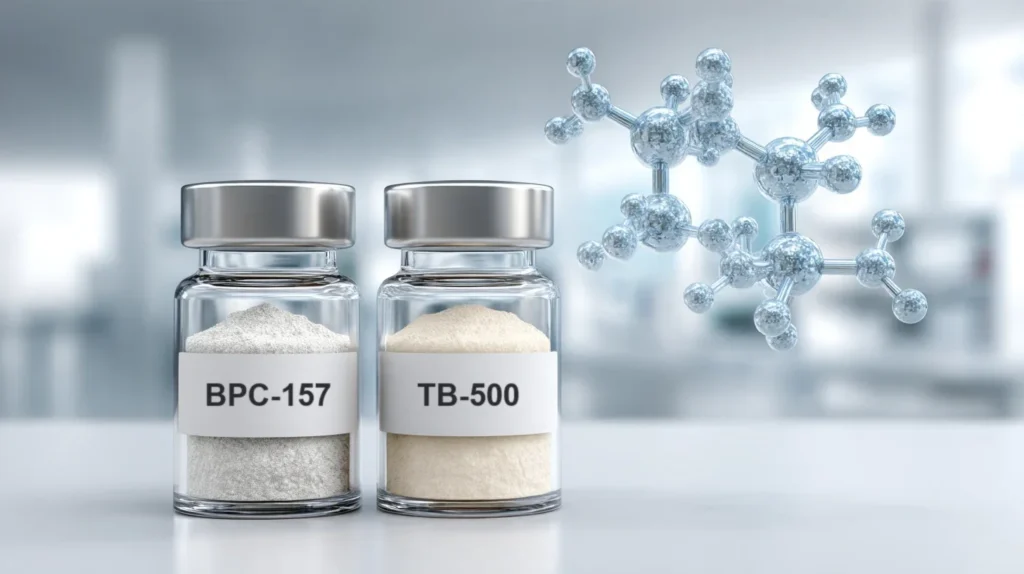
BPC-157 and TB-500 are two research peptides that often appear in the same conversation, and for good reason. Both are studied in animal models of tendon, muscle and wound repair, yet they come from very different sources and work through different pathways. This article compares BPC 157 and TB 500 side by side, explains what the published studies actually show, and covers safety, regulation and storage. Neither peptide is FDA approved for any medical use. This content is for research and educational purposes only and is not medical advice.
What Are BPC 157 and TB 500
BPC-157 is a synthetic peptide made of 15 amino acids. It is a partial sequence of a larger protein, called body protection compound, that was first isolated from human gastric juice [1]. For a full overview of its background, see our article on what BPC-157 is.
TB-500 is a short synthetic peptide with the sequence Ac-LKKTETQ. It copies the active region of thymosin beta-4, a natural protein that cells release after injury [9]. So when people ask what is TB-500, the simple answer is a lab-made fragment of a larger repair protein. Together, BPC-157 and TB-500 are among the most discussed peptides in tissue repair research, mostly because of results in rodent studies.
Where BPC 157 and TB 500 Come From
The two peptides have very different origins, even though both are now made the same way. The BPC-157 and TB-500 used in laboratories today are produced by chemical peptide synthesis, not extracted from tissue. BPC-157 traces back to work on proteins that protect the stomach lining. Researchers identified a 15 amino acid section of this protein and later produced it synthetically for laboratory use [1].
TB-500 comes from thymosin beta-4, a natural 43 amino acid peptide made by many cell types. Thymosin beta-4 binds actin, a protein that helps cells move, and it is released by platelets and macrophages at sites of injury [6]. TB-500 contains only the short actin-binding region of that protein, with an added acetyl group [9]. This means TB-500 is not the same molecule as thymosin beta-4, even though the two names are often used as if they were interchangeable.
What Studies Show About BPC 157
Most BPC-157 research comes from cell cultures and rats. In tendon studies, BPC-157 increased the outgrowth of tendon tissue, improved cell survival under stress and supported cell migration [1]. A follow-up study in rat tendon fibroblasts found that the peptide raised the expression of growth hormone receptors [2]. Other work linked BPC-157 to new blood vessel growth through the VEGFR2 receptor, including faster recovery of blood flow in a rat model of limb ischemia [3].
A 2025 systematic review gathered 36 studies on BPC-157 in orthopaedic research. Of these, 35 were preclinical, and only one involved people [4]. The review also noted that BPC-157 is broken down in the liver with a half-life of under 30 minutes in the studies available. These findings describe what BPC-157 does in laboratory models, not in human patients.
What Studies Show About TB 500
Much of what is said about TB-500 actually comes from studies of full thymosin beta-4. In a rat wound model, thymosin beta-4 applied to the skin or given into the abdomen increased the closure of the skin surface by 42% at day 4 and by 61% at day 7 compared to saline [7]. In mice, thymosin beta-4 promoted heart cell migration and survival and improved heart repair after injury [8].
Research on the TB-500 fragment itself is much thinner. A 2024 study measured how TB-500 breaks down in rats and in human serum. It found that a metabolite called Ac-LKKTE, and not TB-500 itself, showed the wound healing activity in fibroblasts [9]. The same study found that a smaller breakdown product, Ac-LKK, could still be detected in rat urine up to 72 hours later [9]. In other words, what TB-500 does may depend on what it turns into in the body, and that question is still open.
BPC 157 vs TB 500 Side by Side
The table below sums up the main differences between BPC-157 and TB-500 based on the published research. Keep in mind that most entries rely on animal and cell data, not on studies in people.
| BPC-157 | TB-500 | |
|---|---|---|
| Origin | Fragment of a gastric protein [1] | Fragment of thymosin beta-4 [9] |
| Length | 15 amino acids | 7 amino acids, acetylated |
| Main research focus | Tendon, gut, blood vessel growth [1, 3] | Wound healing, cell migration [7, 9] |
| Most cited pathway | Growth hormone receptor, VEGFR2 [2, 3] | Actin binding [6] |
| Human data | Three small studies, very low certainty [5] | Clinical trials of thymosin beta-4 only [11] |
| FDA status | Not approved | Not approved |
One 2026 rat study compared both peptides directly after Achilles tendon repair. Both improved tissue structure, and TB-500 also produced a significantly stronger tendon at four weeks. Combining BPC-157 and TB-500 did not add any extra benefit over either peptide alone [10].
Are BPC 157 and TB 500 Used in Medicine
No. BPC-157 and TB-500 have no approved medical use in the United States, and neither is approved as a drug by the FDA. The human research on BPC-157 is limited to three small studies with 30 people in total, covering knee pain, a bladder condition and an intravenous safety test. A 2026 systematic review rated the certainty of this evidence as very low [5].
TB-500 has no published clinical trials of its own. The parent protein, thymosin beta-4, has been tested in people, for example as eye drops in a Phase II trial for dry eye [11], but it has not been approved for any condition either. The compounding status of both peptides has been under FDA review during 2026, so readers who need the current position should check the FDA’s own bulk drug substance lists.
Why Researchers Study BPC 157 and TB 500 Together
Because BPC-157 and TB-500 act on different pathways, some researchers have asked whether they could work better as a pair. This idea is behind the popular BPC-157 and TB-500 blend, sometimes called the wolverine stack. The 2026 Achilles tendon study is the first direct test of that idea in animals, and it found no additive effect from the combination [10]. The authors suggested that both peptides may act on shared pathways further down the chain, but this still needs confirmation.
For laboratories that study the peptides together, both are available as a BPC-157 and TB-500 research blend and as part of the wolverine bundle. A three-peptide glow blend with GHK-Cu is also used in skin research.
Does BPC 157 and TB 500 Need to Be Refrigerated
Yes, in most cases. Like other research peptides, BPC-157 and TB-500 are supplied as a dry, freeze-dried powder. General laboratory guidance from Sigma-Aldrich recommends storing freeze-dried peptides at -20 °C, or at -80 °C for longer periods, and keeping them away from moisture [14].
So how long does BPC-157 last in the fridge? There are no published stability studies that give an exact number for BPC-157 or TB-500. The same Sigma-Aldrich guidance states that peptides in solution are generally stable for up to about one week at 4 °C, and that repeated freezing and thawing should be avoided [14]. For a specific product, the batch documents and the certificate of analysis should be the final reference.
Safety Data and Regulatory Status
Is BPC-157 safe? There is no established safety profile for humans. Preclinical safety studies in animals reported no adverse effects across several organ systems, but no clinical safety data were found in the 2025 review [4]. A 2026 scoping review of six popular peptides, including BPC-157 and TB-500, concluded that their claimed benefits for recovery remain unproven in human trials [12].
Sports bodies treat both peptides as banned substances. The World Anti-Doping Agency lists BPC-157 under S0, non-approved substances, and TB-500 under S2 as a thymosin beta-4 derivative. Both are prohibited at all times, in and out of competition [13]. Product quality is a separate risk, since contaminated or mislabeled material can cause problems unrelated to the peptide itself.
For this reason, researchers who work with BPC-157 and TB-500 check the paperwork before anything else. A useful certificate of analysis names the compound, the lot number, the test date and the measured purity, usually from HPLC, with mass spectrometry to confirm identity. Third-party testing by an independent lab adds a second check. Matching the lot number on the vial to the lot on the certificate links the documents to the actual material.
Conclusion
BPC-157 and TB-500 are both interesting research peptides, but the evidence behind them is still mostly animal and cell data. BPC-157 is linked to tendon repair and blood vessel growth, while TB-500 borrows its reputation from thymosin beta-4 and wound healing studies. The first direct comparison found that each helped tendon repair in rats, with no extra benefit from combining them. Human data remain very limited for both. This content is for research and educational use only and is not medical advice.
Frequently Asked Questions
Is thymosin beta-4 the same as TB-500?
No. Thymosin beta-4 is a natural 43 amino acid protein. TB-500 is a synthetic, acetylated 7 amino acid fragment that copies its actin-binding region [6, 9].
What is TB-500 used for?
TB-500 is used only as a research compound in laboratory studies, mainly on wound healing and cell migration. It has no approved medical use.
Is TB-500 safe?
Its safety in humans has not been established. TB-500 has no published human clinical trials, and it is banned in sport by WADA [13].
Is TB-500 FDA approved?
No. TB-500 is not FDA approved for any medical use. Neither is BPC-157.
What does BPC-157 and TB-500 do together?
In the only direct animal comparison, each peptide improved tendon repair in rats, but combining them gave no additional benefit [10].
Does BPC-157 and TB-500 build muscle?
There is no evidence that they build muscle in people. A 2026 review found that claims about peptides for muscle recovery and performance are not supported by human trials [12].
Does BPC-157 and TB-500 help with weight loss?
There is no human evidence that BPC-157 or TB-500 causes weight loss. Research on both focuses on tissue repair, not body weight.
What is the difference between BPC-157 and TB-500?
BPC-157 is a 15 amino acid fragment of a gastric protein. TB-500 is a 7 amino acid fragment of thymosin beta-4. They are studied for repair through different pathways [1, 6].
Citations
- Chang CH, Tsai WC, Lin MS, Hsu YH, Pang JH. The promoting effect of pentadecapeptide BPC 157 on tendon healing involves tendon outgrowth, cell survival, and cell migration. Journal of Applied Physiology. 2011;110(3):774-780. PubMed
- Chang CH, Tsai WC, Hsu YH, Pang JH. Pentadecapeptide BPC 157 enhances the growth hormone receptor expression in tendon fibroblasts. Molecules. 2014;19(11):19066-19077. PubMed
- Hsieh MJ, Liu HT, Wang CN, et al. Therapeutic potential of pro-angiogenic BPC157 is associated with VEGFR2 activation and up-regulation. Journal of Molecular Medicine. 2017;95(3):323-333. PubMed
- Vasireddi N, Hahamyan H, Salata MJ, et al. Emerging use of BPC-157 in orthopaedic sports medicine: a systematic review. HSS Journal. 2025;21(4):485-495. PubMed
- Poolton JT, Minett J, Kazmi A. Human evidence for BPC-157 in orthopaedic and regenerative medicine: a systematic review of efficacy and safety. Acta Orthopaedica Belgica. 2026;92(3). PubMed
- Goldstein AL, Hannappel E, Sosne G, Kleinman HK. Thymosin β4: a multi-functional regenerative peptide. Basic properties and clinical applications. Expert Opinion on Biological Therapy. 2012;12(1):37-51. PubMed
- Malinda KM, Sidhu GS, Mani H, et al. Thymosin beta4 accelerates wound healing. Journal of Investigative Dermatology. 1999;113(3):364-368. PubMed
- Bock-Marquette I, Saxena A, White MD, Dimaio JM, Srivastava D. Thymosin beta4 activates integrin-linked kinase and promotes cardiac cell migration, survival and cardiac repair. Nature. 2004;432(7016):466-472. PubMed
- Rahaman KA, Muresan AR, Min H, et al. Simultaneous quantification of TB-500 and its metabolites in in-vitro experiments and rats by UHPLC-Q-Exactive orbitrap MS/MS and their screening by wound healing activities in-vitro. Journal of Chromatography B. 2024;1235:124033. PubMed
- Biçer O, Adanir O, Güleryüz Y, et al. Effects of BPC-157 and TB-500 on Achilles tendon healing in rats: a histopathological and biomechanical study. Joint Diseases and Related Surgery. 2026;37(3):822-837. PubMed
- Sosne G, Ousler GW. Thymosin beta 4 ophthalmic solution for dry eye: a randomized, placebo-controlled, Phase II clinical trial conducted using the controlled adverse environment (CAE) model. Clinical Ophthalmology. 2015;9:877-884. PubMed
- Tewari K, Liu TP, Im C, et al. Peptide supplements and their therapeutic applications in sports medicine. American Journal of Sports Medicine. 2026. PubMed
- World Anti-Doping Agency. The 2026 Prohibited List. WADA
- Sigma-Aldrich. Handling and storage guidelines for peptides. Sigma-Aldrich